
Why Choose A Jewellery Manufacturer For Custom Jewellery Development?
Custom jewellery development requires more than access to finished stock. It demands coordinated technical capacity, material knowledge, and process control that allow brands to move from original concepts to market-ready pieces with consistency. Selecting a specialised manufacturer for this work provides structural advantages that support design integrity, production reliability, and long-term collection building.
Role of Integrated Manufacturing in Custom Development
A capable manufacturer manages the full sequence from early ideas through to packaged delivery. This integration reduces fragmentation and helps maintain design intent at every stage. When brands work with a partner that combines design support, production expertise, and quality systems under one operational framework, the path from concept to finished jewellery becomes more predictable and controllable. Working with an experienced Manufacturing Company for Gold Jewelry can also help brands maintain consistent craftsmanship, quality standards, and production efficiency throughout the manufacturing process.
Trusted Manufacturing Partner for International Brands –
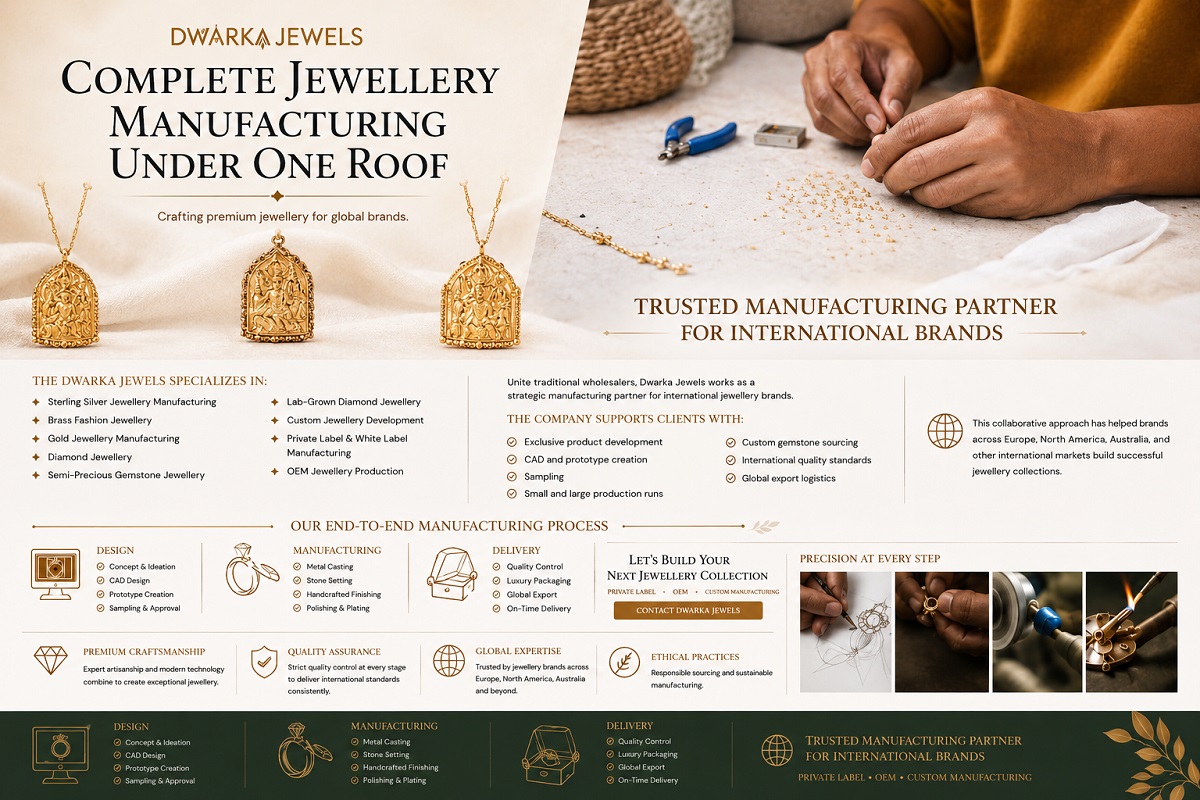
Dwarka Jewels Specializes In: Sterling silver jewellery manufacturing, brass fashion jewellery, gold jewellery manufacturing, diamond jewellery, semi-precious gemstone jewellery, lab-grown diamond jewellery, custom jewellery development, private label and white label manufacturing, and OEM jewellery production.
From concept sketches to finished luxury packaging, every stage is managed with precision and strict quality control.
Unlike traditional wholesalers, Dwarka Jewels works as a strategic manufacturing partner for international jewellery brands.
The Company Supports Clients With: Exclusive product development, CAD and prototype creation, sampling, small and large production runs, custom gemstone sourcing, international quality standards, and global export logistics.
This collaborative approach has helped brands across Europe, North America, Australia, and other international markets build successful jewellery collections.
Advantages of Working with a Dedicated Manufacturing Partner
Unlike suppliers limited to wholesale distribution, a strategic manufacturing partner participates directly in the development process. Exclusive product development protects brand distinctiveness. CAD and prototype creation translate ideas into precise models and physical samples. Sampling allows detailed review before larger commitments. Both small and large production runs can be accommodated according to market needs. Custom gemstone sourcing aligns materials with design requirements. International quality standards are applied throughout, and global export logistics manage the practical requirements of delivering finished collections to destination markets.
This model supports brands that require more than ready-made inventory. It enables the creation of original ranges while relying on specialised technical capacity rather than building internal manufacturing infrastructure.
Structured Process from Design Through Delivery
Our End-To-End Manufacturing Process –
- Design: The design process includes concept and ideation, CAD design, prototype creation, and sampling and approval. These stages establish clear creative and technical direction before production begins. Concept and ideation sessions define the overall vision. CAD design converts that vision into accurate digital representations. Prototype creation produces physical versions for evaluation. Sampling and approval confirm that all details meet the required standards.
- Manufacturing: The manufacturing process includes metal casting, stone setting, handcrafted finishing, polishing and plating. Metal casting forms the structural foundation of each piece. Stone setting secures gems with attention to alignment, security, and visual balance. Handcrafted finishing introduces refined detail. Polishing and plating complete the surface treatment to achieve the desired appearance and durability.
- Delivery: The delivery process includes quality control, luxury packaging, global export, and on-time delivery. Quality control verifies that finished items meet established criteria. Luxury packaging prepares the jewellery for presentation and protection. Global export handles documentation and shipping arrangements. On-time delivery ensures collections arrive according to agreed schedules.
Standards That Support Reliable Custom Work
- Premium Craftsmanship: Expert artisanship and modern technology combine to create exceptional jewellery. The combination of traditional skill and contemporary tools supports both intricate detail and consistent results across production volumes.
- Quality Assurance: Strict quality control at every stage to deliver international standards consistently. Checks occur during design approval, manufacturing, and final inspection so that finished pieces meet the expectations of diverse retail markets.
- Global Expertise: Trusted by jewellery brands across Europe, North America, Australia, and beyond. Experience with international clients informs process design, documentation, and logistical coordination.
- Ethical Practices: Responsible sourcing and sustainable manufacturing. Attention to material origins and production methods contributes to long-term reliability and aligns with broader industry expectations.
- Precision At Every Step: The jewellery manufacturing process focuses on precision at every stage, from detailed design and stone setting to polishing, finishing, and final craftsmanship. This emphasis on accuracy helps preserve design intent from the first sketch through to the completed piece.
Application Across Specific Jewellery Categories
When brands require work in gold, a specialised Manufacturing Company for Gold Jewelry provides the technical capacity to handle purity standards, casting behaviour, and finishing requirements particular to the metal. The same integrated systems support other materials and product types, allowing coherent quality across a full collection.
For designs that include a sterling silver ring for men, manufacturers with comprehensive capabilities can address proportion, comfort, sizing accuracy, and surface durability. These considerations remain central to pieces intended for regular wear. The ability to manage both design development and production within one framework helps maintain consistency between prototype and finished ring.
Wholesale Earrings in Bulk production benefits from the same process control. Capacity for larger runs can be combined with attention to stone setting, finishing, and packaging so that bulk quantities retain the standards established during sampling. This balance supports brands that need volume without sacrificing detail.
Practical Benefits for Brand Development
Custom jewellery development involves repeated cycles of refinement. Access to CAD modelling, physical prototyping, and controlled sampling reduces uncertainty at each stage. Once designs are approved, the manufacturer can scale production while applying the same quality systems used for smaller runs. Private label, white label, and OEM arrangements further allow brands to present finished jewellery under their own identity while relying on specialised production support.
The concentration of skills in design interpretation, metalwork, gemstone setting, and finishing within one operational structure shortens communication chains and reduces the risk of misalignment between concept and result. International experience informs the handling of documentation, packaging standards, and shipping requirements that affect how collections reach retail markets.
Supporting Long-Term Collection Building
Manufacturers that combine exclusive development capacity with reliable production systems enable brands to plan collections over multiple seasons. The ability to source specific gemstones, adjust production volumes, and maintain consistent finishing supports both experimental limited editions and established core ranges. Ethical sourcing practices and attention to process precision contribute to the credibility of the finished jewellery in markets that increasingly value transparency and quality documentation.
When these elements operate together, custom jewellery development becomes a structured collaboration rather than a series of disconnected transactions. The manufacturer’s role extends beyond fabrication to include technical guidance, quality oversight, and logistical coordination that help brands realise their design objectives with greater reliability. This approach also allows manufacturers to develop diverse products, from bespoke collections to designs such as a Sterling Silver Ring for Men, while maintaining consistency in craftsmanship, finishing, and quality standards.
Conclusion
Choosing a specialised jewellery manufacturer for custom development rests on the practical advantages of integrated process control, technical depth, and collaborative capacity. Partners that manage exclusive product development, precise prototyping, controlled manufacturing, and reliable delivery create conditions in which original designs can move from concept to finished collection with consistency. Capabilities covering gold work through a Manufacturing Company for Gold Jewelry, pieces such as a Sterling Silver Ring for Men, and volume needs addressed by Wholesale Earrings in Bulk illustrate the range of requirements that can be supported under unified standards. When these systems operate through a strategic manufacturing relationship focused on precision, quality assurance, and ethical practice, the outcome is reliable production that supports sustained collection development across international markets.
Frequently Asked Questions (FAQs)
Que. What distinguishes a strategic manufacturing partner from a traditional wholesaler?
Ans. A strategic partner participates in exclusive product development, CAD and prototype work, sampling, production scaling, custom material sourcing, quality control, and export logistics rather than limiting involvement to the supply of finished stock.
Que. How does the design stage support custom jewellery development?
Ans. The design stage includes concept and ideation, CAD modelling, prototype creation, and sampling with approval, establishing clear creative and technical direction before manufacturing begins.
Que. Which processes occur during the manufacturing phase?
Ans. Manufacturing includes metal casting to form structures, stone setting to secure gems, handcrafted finishing for detail, and polishing and plating to complete surface treatment.
Que. How is quality maintained across custom production?
Ans. Strict quality control is applied at multiple stages, from design approval through manufacturing and final inspection, to deliver consistent international standards.
Que. What additional principles guide the manufacturing approach?
Ans. Premium craftsmanship combines artisan skill with modern technology, global expertise informs international coordination, ethical practices address responsible sourcing, and precision is maintained at every step from design through final finishing.